
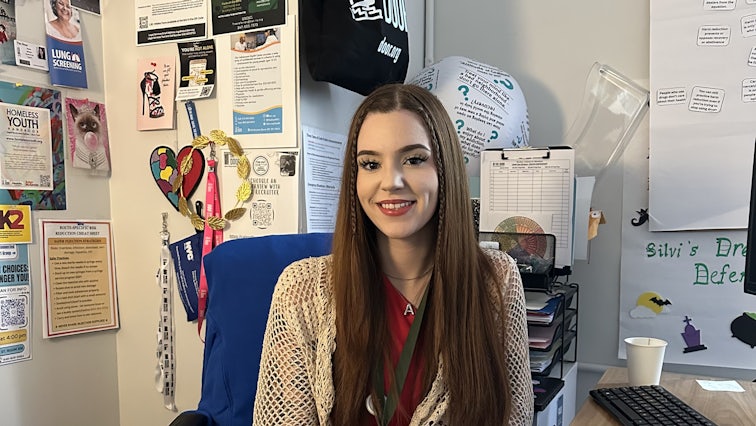
Alyssa: Meeting Young People Where They Are
For Alyssa Seibert, creating safe spaces for young people starts with listening without judgment. As The Door’s Harm Reduction Counselor, Alyssa supports young people navigating substance use, mental health challenges, housing instability, and recovery. More than anything, her work is about helping young people feel seen, respected, and empowered to make healthy choices for themselves. “We have to accept that there are some realities of the world,” Alyssa says. “Young people are deserving of care and dignity, even if they’re engaging in behaviors we may not agree with or know are unsafe.”
Alyssa joined The Door four years ago as a Career Advancement Coach before stepping into her current role in March 2025. As the first Harm Reduction Counselor at The Door, she has helped build a new kind of support system for young people rooted in empathy, patience, and autonomy. A large part of Alyssa’s work happens on the first floor, where she blends one-on-one counseling with community engagement. She facilitates Harm Reduction Hangout, a drop-in space where conversations about safer substance use happen through games like Jeopardy, Scattergories, Bingo, and word searches. “It’s a way to make learning about harm reduction accessible and fun,” she explains. “Young people might come over because they see a game, and then they stay even when they realize we’re talking about serious topics.” Every Friday, Alyssa also runs Safer Choices, Stronger You, a peer support group where five to seven young people gather weekly to discuss substance use, recovery, relapse, and healing. “So much healing happens in community,” she says. “Young people realize they’re not alone. They hear someone else say, ‘I’ve experienced that too,’ and some of the stigma starts to disappear.”
Alyssa recalled working with a young person who had been kicked out of their home due to substance use. When they first came to The Door, they were struggling with multiple substances and were not ready to stop. Instead of turning them away, Alyssa continued meeting with them week after week. “They told me, ‘I’m not ready to stop this drug,’” she says. “So instead of saying, ‘Then we can’t work together,’ I said, ‘Okay. Let’s keep talking about it. Let’s talk about how we keep you safe while you navigate this.’” Over time, through consistency and trust, the young person began reducing their substance use and stepping away from behaviors that had become harmful. “We celebrate any positive change,” Alyssa says. “Even small steps matter.”
Those celebrations can look different for each young person, reducing alcohol use, returning from inpatient treatment, maintaining sobriety, or securing stable housing after homelessness. Alyssa notes that many young people use substances to survive difficult circumstances, making housing and emotional support essential parts of recovery. At the same time, the work requires balancing compassion, safety, and accountability. “I’ll be in the passenger seat with a young person,” Alyssa says. “But I will never be in the driver’s seat.” Rather than pushing treatment or perfection, she focuses on helping young people make informed, safer choices while knowing they still deserve care and support.
Much of her work is also deeply connected to mental health. Alyssa collaborates with counseling and mental health teams across The Door, connecting young people to therapy, psychiatric care, housing support, education programs, and arts programming. “There’s such a strong connection between substance use and mental health,” she says. “The connection can’t be overstated.” As Mental Health Awareness Month highlights the importance of accessible care, Alyssa hopes young people know they don’t need everything figured out before asking for help. “It doesn’t have to start with weekly therapy,” she says. “It can be as simple as coming to hang out, having lunch together, or stopping by to talk. Just start somewhere.” For Alyssa, that first step can open the door to something bigger: healing, stability, and the reminder that no young person should have to navigate life alone.
Alyssa has also spearheaded The Door’s first Harm Reduction Fair, furthering the mission to create spaces where young people can access potentially life-saving resources. The fair consisted of 12 community organizations that provided information on a range of services, including mental health support, counseling, Narcan distribution, detox, and outpatient and inpatient treatment. Convening trusted partners in one place helped reduce barriers to care and reinforced The Door’s belief that every young person deserves compassionate, judgment-free support as they navigate their health and well-being.
Through The Door’s association with the 1199 Union and their training and employment funds, Alyssa has also completed her master’s degree in Youth Studies at the CUNY School of Professional Studies and graduated this May. She plans to pursue her CASAC credentials (Credentialed Alcoholism and Substance Use Counselor). After work, Alyssa finds grounding in the small things, including going home to her cat and spending time with her family, but what stays with her most are the young people. Seeing their resilience and growth over time is what keeps her going.